
The PTA reimbursement process is how a person gets paid back for something they bought for the organization, with the controls a nonprofit needs along the way. Someone submits a request with receipts, the expense is authorized against the budget, two authorized officers approve releasing the money, the PTA pays by check or electronic transfer, and the treasurer records and reconciles it. Most treasurers run all of this the hard way: on paper forms and checks, or a cobbled-together mix of spreadsheets, email threads, and a folder of receipts. Every step is a handoff, adds a delay, and introduces an opportunity for error, which is how a reimbursement that should take days ends up taking weeks.
I served as a PTA treasurer for three years across two school districts and trained the treasurers who came after me. Reimbursements were the part of the job that took the most time and caused the most problems: the paper request that sat in a box unseen, double-checking budgets, running forms and checks around to get signed, and keeping that all in sync with the books. This guide walks the process and shows where each step can be made faster.
A quick note: the steps below reflect the financial procedures most PTAs, PTOs, and booster clubs follow. The exact form names and dollar thresholds vary from one organization to the next, so always check your own bylaws and procedures.
The process at a glance
- Collect the request and the receipts
- Authorize the expense (is it budgeted, and has the membership released the funds?)
- Release the payment with two authorized signers
- Pay it, by check or, more easily, by electronic transfer
- Record and reconcile it
Steps 2 and 3 are different controls that often get blurred together, and every step in the list is a handoff that can stall. Here is what each one means, and where each one can be made faster.
Step 1: Collect the request and receipts
 Every reimbursement starts with a written request and the original receipts. If you need to tip a vendor, get them to include that on their invoice or have them write a receipt detailing the tip.
The form for this is the Payment Authorization/Request for Reimbursement: who is being paid, the date, an itemized description, the budget line it belongs to, the total, and the receipts attached. A good request also asks the submitter to suggest the budget category, so the expense reaches the treasurer already coded instead of as a mystery you have to research later. For a field-by-field breakdown of that form, plus a free template you can download, see what to put on a PTA reimbursement form.
Step 2: Authorize the expense
Before any money moves, the expense has to be authorized, and the catch is that adopting the budget does not by itself authorize a given expense. Most PTA procedures boil authorization down to three questions worth memorizing before you pay anything:
- Is the expense within the approved budget?
- Has the spending been released by the membership, or authorized by the board within the limits your bylaws set and ratified by the membership?
- Is there a completed Payment Authorization form, with receipts attached, signed by the president and secretary?
If yes, you can pay it. The president’s and secretary’s signatures on that form document that the expense itself was properly authorized. This is different from the two signatures on the payment, which comes next.
Check the budget line before you pay, not after. “In the approved budget” means more than the category existing. It means the line still has money left in it. Standard PTA procedure is firm on this: funds have to be authorized before they are spent, spending should not exceed the approved amount, and the treasurer should hand the board a budget-to-actual comparison at least quarterly. An over-budget or unbudgeted expense carries real risk: it has to be ratified by the membership, and if it is not, the executive board that authorized the spending could be personally liable for the funds.
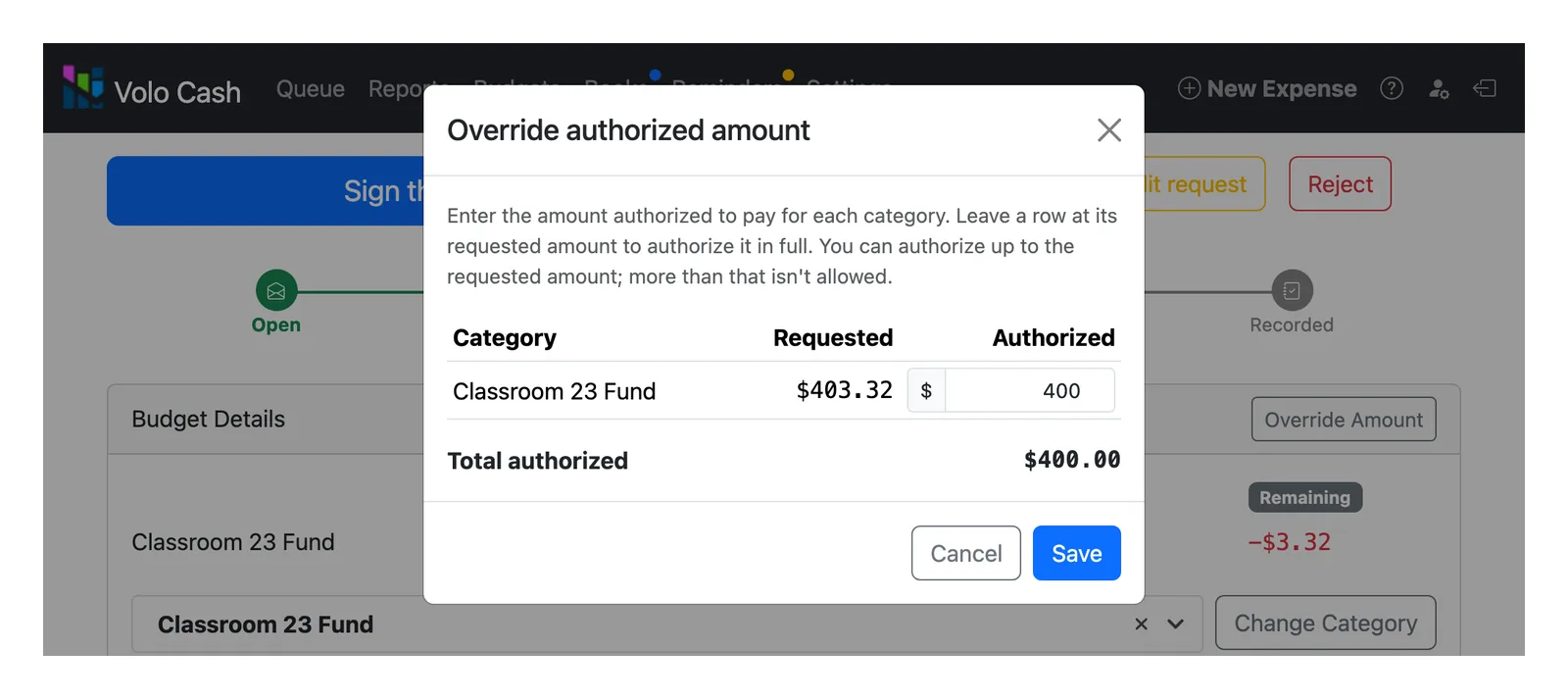
Authorizing a partial amount in Volo Cash to match your records to what you actually paid.
Step 3: The two-signature rule, explained
Now the payment itself has to be released by two authorized check signers. The purpose is simple: no single person should be able to move the organization’s money alone.
A few things most PTA bylaws are specific about:
- At least three elected officers should be authorized signers, two of whom are the president and treasurer, and any two of them sign a given payment.
- The signers cannot be related by blood or marriage, or live in the same household, and the person being reimbursed cannot be one of them.
- The rule covers electronic payments, not just checks. The expectation is two signatures on all checks and electronic transactions alike, whether that is a debit, ACH/EFT, or bank bill pay payment.
Something to keep in mind: most banks do not actually verify the second signature on a check. That means the two-signature control is really a procedural one that you document yourself, not something the bank enforces at the teller window.
Step 4: Pay it, ideally without a paper check
The payment is the last handoff, and on paper it is the slowest one. The traditional method is a check that two officers sign in ink, which means printing it and physically carrying it to two people’s homes for signatures. Then handing the check to the recipient or addressing, stamping, and mailing it to them.
You do not have to do it that way. Most PTA financial procedures treat Electronic Funds Transfer, ACH, and bank bill pay as an approved way to pay expenses. The condition is the part that matters:
An electronic-payment authorization, signed by two authorized check signers, must be completed for every EFT, ACH, or bank bill pay payment.
The two required signatures do not have to land on the check. They can land on an electronic-payment authorization instead. Once two authorized signers have signed it, you pay the expense straight through your bank’s bill pay, and the signed authorization is your documented proof that two people approved releasing the money. Same control, no paper check, no driving around, and most banks will mail a check via bill pay for you for free.
Step 5: Record and reconcile
 The reimbursement is not finished when the money goes out. Record the payment against the right budget line, then reconcile it against the bank statement.
Most PTAs add a control here that is easy to honor and worth doing: the monthly bank statement and reconciliation should be reviewed and signed by a non-check signer, often the financial reviewer. A quick monthly review confirms two signatures or a documented authorization on every payment, confirms each electronic payment was pre-authorized and matches the minutes, and confirms no cash withdrawals were made. A reimbursement that has a request, receipts, a documented authorization, and a matching bank entry is one nobody can question at your year-end financial review.
Common mistakes to avoid
- Reimbursing without receipts. A common finding in a PTA financial review and an easy one to avoid.
- Approving an expense without checking what is left in the budget line. You find out you overspent a category only when it is too late to do anything about it.
- Letting the payee approve or sign their own reimbursement. A basic control failure, and an easy one to prevent.
- Treating electronic payments as exempt from the two-signature rule. They are not. They just use a signed authorization instead of ink on a check.
- Paper-checking everything out of habit. There is a faster, fully approved path, and most of the volunteer complaints about reimbursements come from not using it.
- A trail that lives in your inbox. If the only record of an approval is an email thread, it will not survive the handoff to next year’s treasurer.
A simple reimbursement checklist
For every reimbursement, you should be able to answer yes to all of these:
- There is a request with the payee, amount, and an itemized description.
- The original receipts are attached.
- It is within the approved budget with funds remaining in the line and the membership has released the funds.
- The Payment Authorization form is signed by the president and secretary.
- The payment is released by two authorized signers, on the check or on an electronic-payment authorization, and none of them is the payee.
- It is recorded in the books and will be reconciled with the statement reviewed by a non-check signer.
The whole process, without the paper
Look back at those five steps and count the handoffs: a volunteer gets a form to you, you check a budget you have to go look up, you collect signatures one officer at a time, you route a check to two more people, and then you write it all into the books. Every handoff is a place the reimbursement stalls. That is the real reason reimbursements feel slow. It is not one broken step, it is a whole process held together by paper and follow-up.
That end-to-end flow is what we built Volo Cash to replace:
- A person submits without an account. They fill out one form on their phone, choose the budget category, and attach the receipt. No login, no paper request to lose.
- You see the budget as you approve. The request arrives already coded, with the remaining balance for that line shown before you say yes.
- The right people sign. Volo Cash collects the signatures your bylaws require. No coordinating times for signing stacks of paper.
- The payment authorization is generated for you. When the last check-signer approves, you have a documented electronic-payment authorization and can pay straight through your bank’s bill pay.
- And the bonus: it lands in your books automatically. The moment the expense is paid, it is recorded against the right budget line in your ledger. There is no second bookkeeping step, and reconciliation becomes matching your bank activity to entries that are already there.
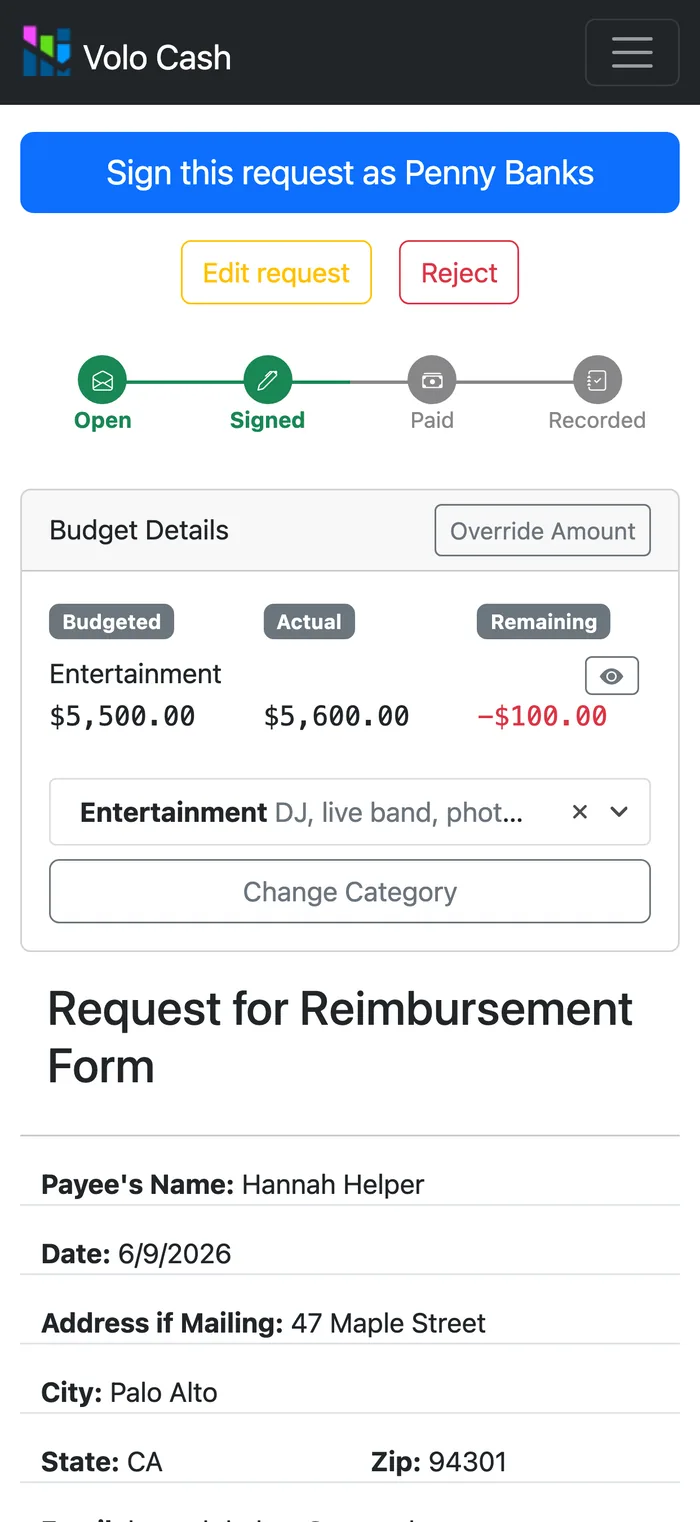
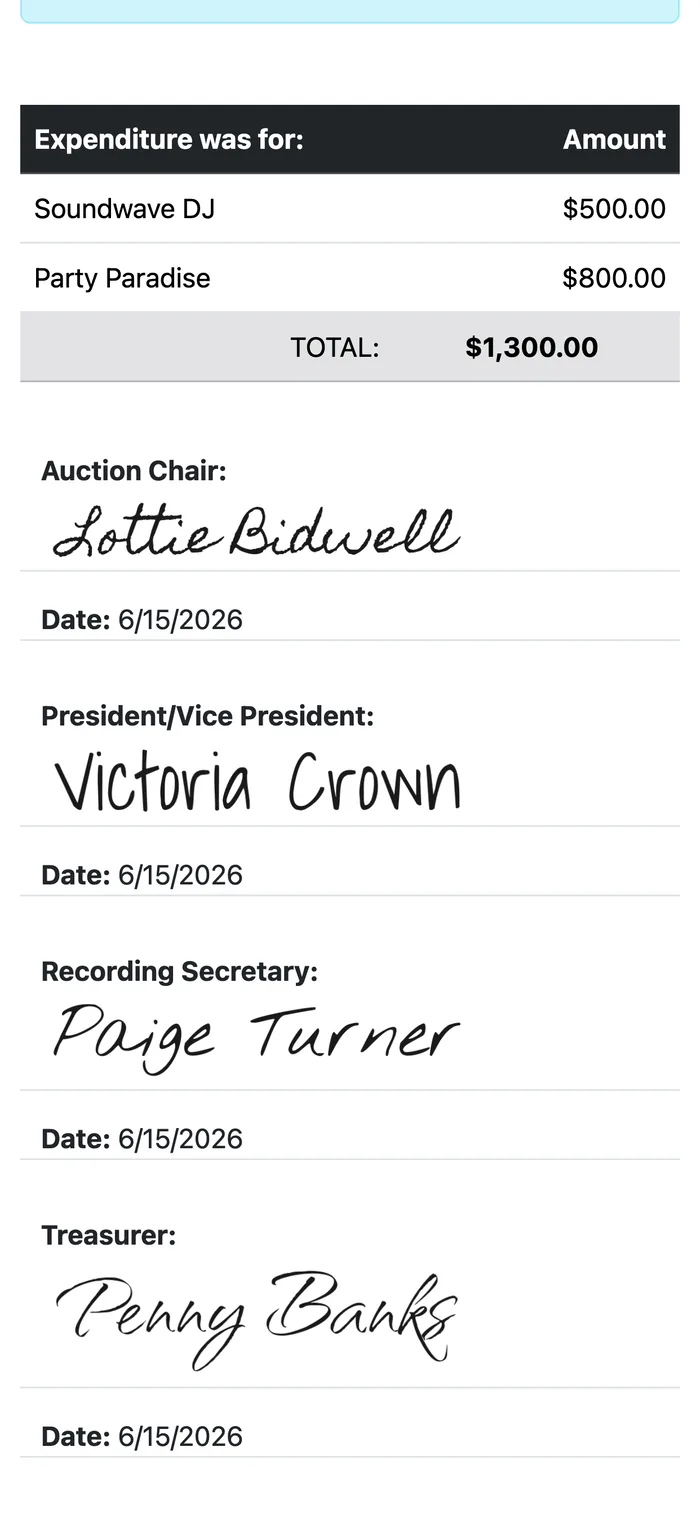
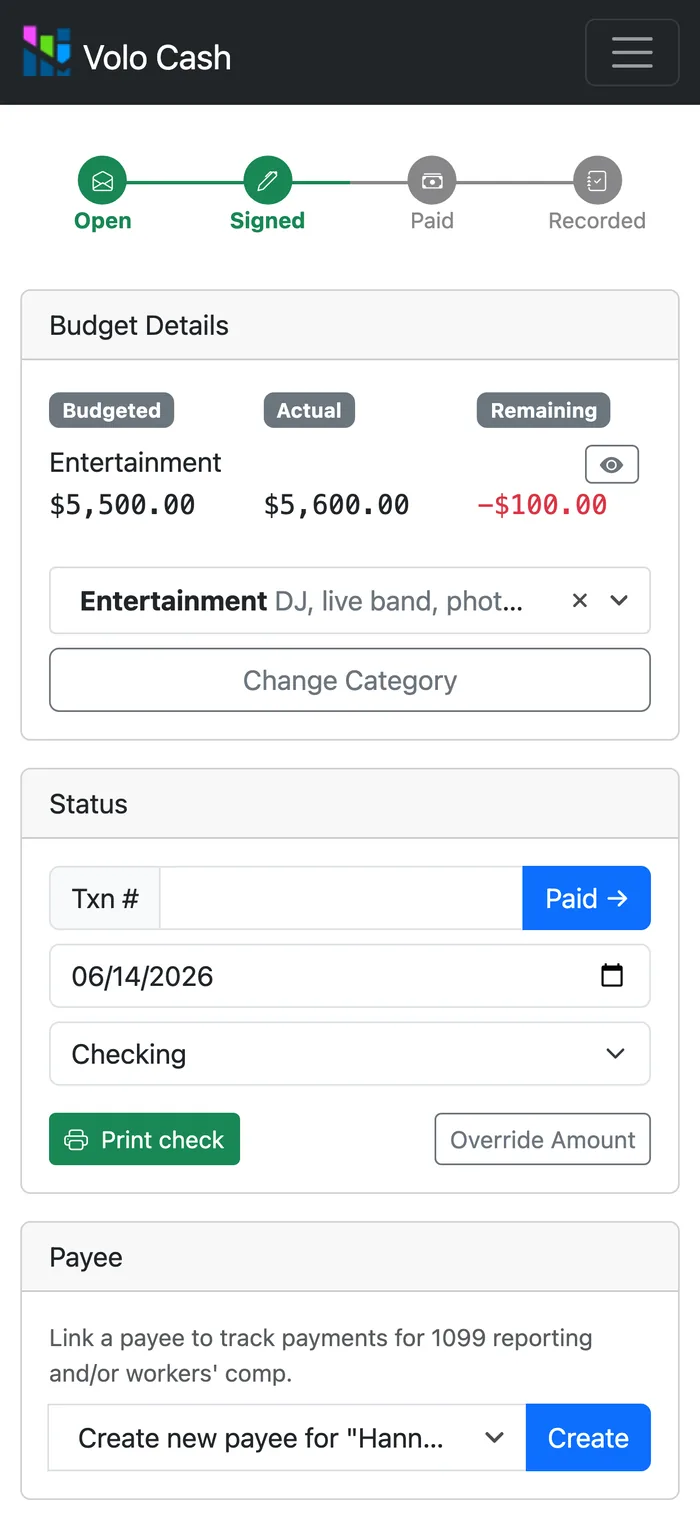
That is the whole reimbursement process, from a volunteer’s phone to your year-end books, without paper forms, a chased check, or a weekend with a spreadsheet. You can try it free for three months and run a real reimbursement through your own organization’s setup.
For a wider look at the tools in this space, see our honest roundup of the best PTA treasurer software, or the head-to-head Volo Cash vs MoneyMinder comparison.