
A PTA classroom fund is a set amount the PTA budgets for each teacher to spend on their classroom during the year, usually a few hundred dollars. Teachers buy what their room needs and are reimbursed against receipts, or the PTA hands the money to the school to manage. A short written policy can help make things clear.
I’ve run classroom funds in various ways during my years as treasurer. The consistent themes seem to always be:
- an increasing number of requests about how much budget is left over time
- the level of organization and accuracy on requests varies greatly
- ineligible and over-budget requests appear
I find it best to meet people wherever they are. Teachers already have a lot on their plate, and anything I can do to support them and reduce the amount of time they spend thinking about something other than students is well worth my time. Volo Cash is designed to save everyone time.
A quick note: this reflects the financial procedures most PTAs, PTOs, and booster clubs follow. Your bylaws and your state or council guidance come first. Adapt what follows to fit.
Why a classroom fund beats a wish list
 Many classrooms start the year with a supply wish list sent home to families. A classroom fund does the same job better in two ways.
- Donations become tax deductible. Parents make tax-deductible donations to their PTA, a registered nonprofit, which supports classroom funds and other programs.
- Every family is covered. While there are social pressures to contribute either way, funding supplies through the PTA keeps always-observant children from feeling like they are the only ones without new supplies or a bag of supplies to contribute to the classroom.
Teachers also get to pick what they need, instead of receiving twelve boxes of tissues and no glue sticks.
Setting the amount
Start from class size and a realistic supply list. Here is an example for a class of 24:
| Item | Estimate |
|---|---|
| Crayons, markers, and colored pencils | $40 |
| Pencils, erasers, and a sharpener | $25 |
| Glue sticks and replacement scissors | $25 |
| Construction paper and chart paper | $35 |
| Dry-erase markers and erasers | $30 |
| Tissues, wipes, and hand sanitizer | $45 |
| Books for the classroom library | $60 |
| A learning game or math manipulatives | $40 |
| Per classroom | $300 |
Multiply by the number of classrooms and you have the budget line. Twenty classrooms at $300 is $6,000. Classroom funds run from $100 to about $1,000 per room, depending on your classroom sizes and what your PTA raises. Scale the list to fit. After the first year, last year’s actual spending is a better guide than any estimate.
You should also decide if specialists like the librarian, PE, music, and art teachers, plus counselors and special education rooms should be included. Each can have unique needs that might call for more or less than a typical classroom.
What the money can buy
Crayons are an easy yes. AirPods are an easy no. The trouble is everything in between: is a cozy blanket for the reading corner, or for the teacher’s couch at home? Remote teaching during the pandemic blurred those lines further, since a home office suddenly was the classroom.
A good rule of thumb: does it stay in the classroom, where a future teacher could use it? Supplies, books, games, organizers, and consumables that get used up in the room all pass. Personal items, things that go home, and anything that only makes sense for one person do not.
Stay away from gift cards. A gift card works like cash handed to one person, and PTA money generally can’t become a personal gift (more on that in whether PTA donations are tax deductible). A gift card also leaves no record of what it bought, so there is no way to show the money stayed in the classroom. Reimburse against receipts or pay the vendor directly instead.
Three ways to run it
However you set the amount, someone has to manage the spending. There are three common setups, and each trades effort for control.
One budget, handed to the school or district
The PTA budgets a single line and sends the money to the school or district, which manages each teacher’s share.
- Pros: it is the least work for the treasurer, and the PTA never has to tell a staff member no.
- Cons: you have no insight into or control over how the money is spent. Unspent funds sit with the district. Someone has to follow up at year end to get them back or have them applied as a credit for next year’s fund.
Send the money with a short letter stating what it is for and what should happen to anything unspent. In Volo Cash, a reminder set for late spring or early in the school year makes sure the follow-up survives the treasurer turnover.
One budget, managed by the PTA
The PTA keeps a single “classroom funds” line and reimburses teachers directly, tracking each teacher’s share on the side.
- Pros: you have full visibility and the flexibility to absorb small overages without a vote when it makes sense.
- Cons: every request comes to you, teachers will ask how much they have left, and you end up keeping a spreadsheet of each teacher’s balance.
Volo Cash takes the submissions off your plate: teachers file a request with their receipts, no account needed, and it routes for approval under your bylaws. The per-teacher tracking still lives on the side.
One budget line per classroom
Every classroom gets its own line in the budget.
- Pros: each room is tracked automatically, teachers can check their own balance, and you have complete insight and control.
- Cons: it is more lines to set up each year and adjust as staff change, and a teacher who goes over their line needs a decision.
In Volo Cash, each classroom line shows its remaining balance as requests come in, and teachers can be invited as budget viewers to check their own line anytime without a board role. You can make the principal a pre-approver on classroom lines. The “is this appropriate?” call then lands with someone who knows the room.
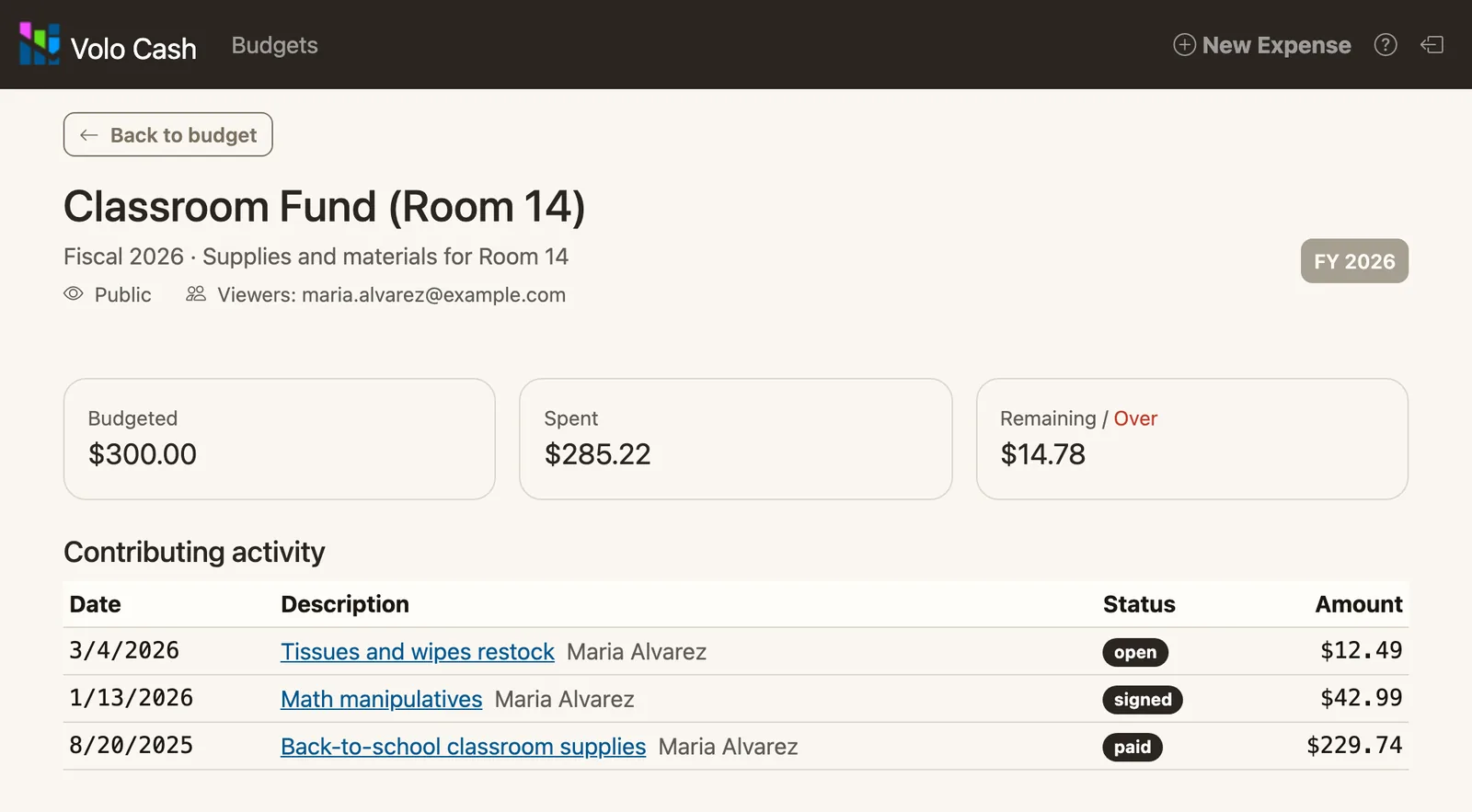
A teacher invited as a budget viewer sees their own classroom’s line and every request against it.
For overages, pick one approach and put it in the policy:
- Pay up to the limit. Volo Cash can override the reimbursement amount to the amount you want to approve while preserving the original request for your records.
- Build in a cushion. Budget each line 10% above the amount you tell teachers, and treat the budgeted figure as the real limit.
- Keep a small overage line. Budget a separate classroom overage amount and split the extra onto it when you approve a request. Mark this category as “private” in Volo Cash, and it can only be applied by a configured user.
Checking the omni-request
Teachers really know how to stretch a budget and even a request with few hundred dollars might cover 10 receipts, across 7 different stores, shared with you as a mix of multipage PDFs, pictures of multiple documents, and a cat photo for good measure. Before you pay, you want to confirm that every line item has a receipt, the totals add up, and nothing claimed falls outside the policy.
- Ask for an itemized request. A line per item, or per group of like items, beats a single total you have to reverse-engineer.
- Mark mixed receipts. When one trip covers classroom and personal items, the teacher marks which lines they are claiming.
- Check it against the policy too. A total can add up and still include something the fund does not cover.
Volo Cash has a receipt match view for this: you step through each receipt page, tick the line items it covers, and it tells you when anything is missing.
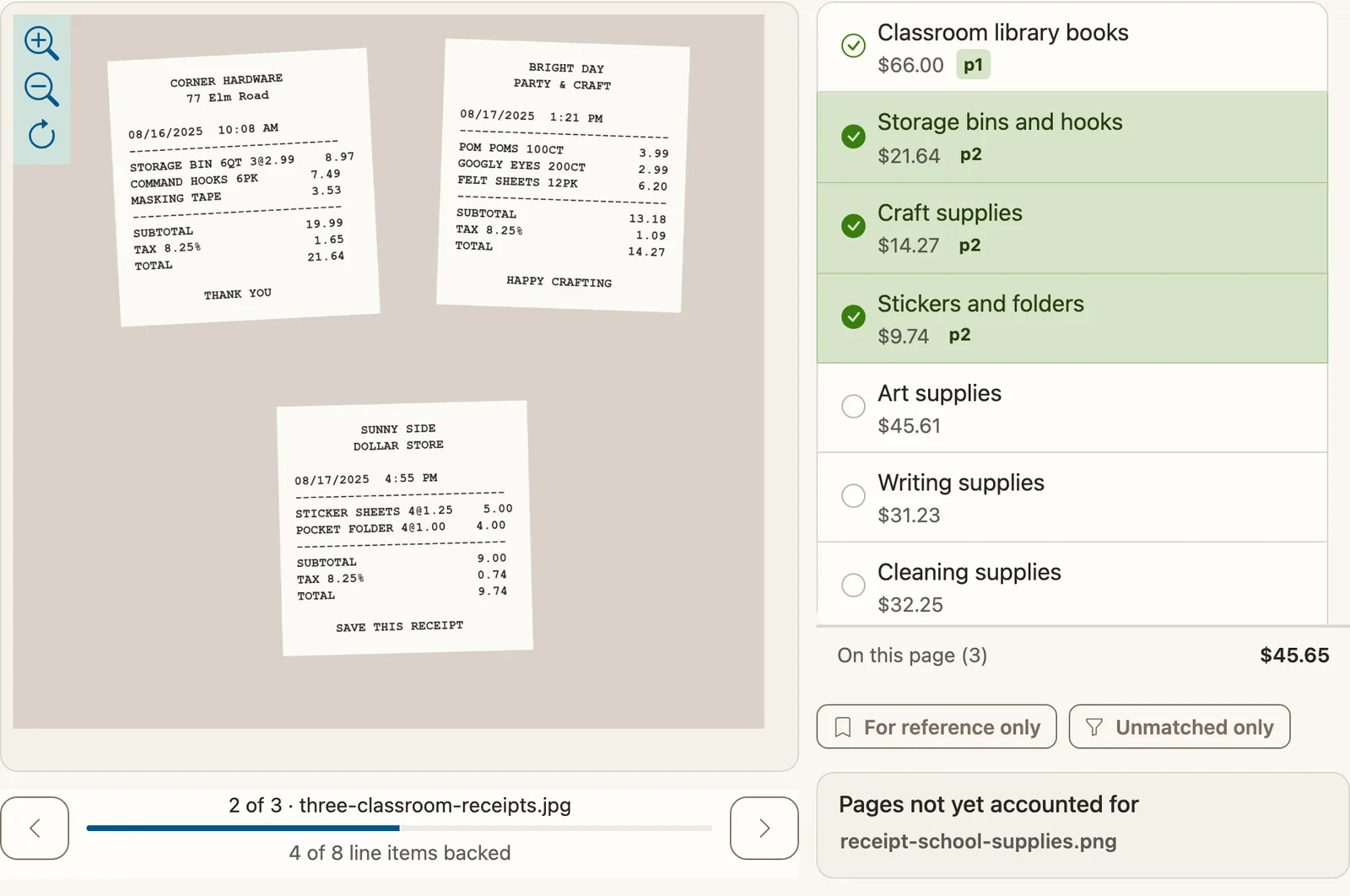
One photo can hold several receipts. Each is matched to the line item it backs, and the page total is checked against them.
A sample classroom funds policy
Adopt it with the budget so everyone knows the rules before the first receipt arrives. Adjust the numbers and dates to fit your PTA.
[PTA name] Classroom Funds Policy
Purpose. Each classroom receives an annual allowance for supplies and materials that support students.
Amount. Each homeroom teacher receives $[amount] per school year. Specialists and support staff receive $[amount].
What qualifies. Items that stay in the classroom and that a future teacher could use: supplies, books, games, and classroom consumables.
What does not qualify. Gift cards, personal items, food, candy, items for use at home, and gifts of any kind.
Timing. Purchases dated within the fiscal year ([July 1] to [June 30]) qualify.
How to request. Submit an itemized request with receipts within [30] days of purchase.
Deadline. All requests are due by [May 15].
Overages. Reimbursement is limited to the remaining allowance unless the [treasurer / board] approves otherwise.
Unspent funds. Allowances do not roll over. Unspent funds return to the PTA’s general fund at year end.
Reminders keep the policy on schedule from one treasurer to the next: send it to staff when school starts, check in with the district on last year’s funds, and remind staff before the spring deadline.
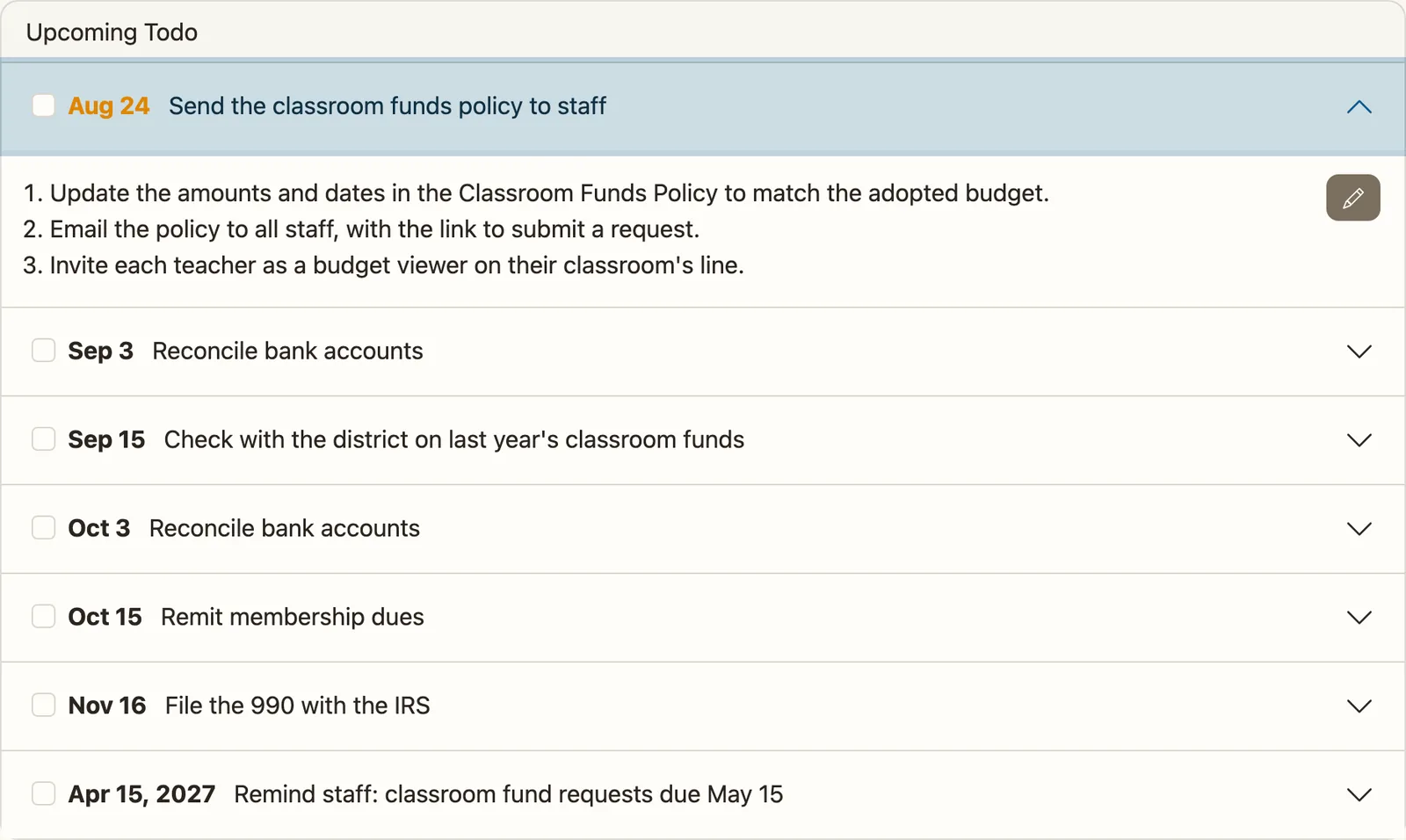
Classroom fund reminders sit alongside the rest of the treasurer’s year.
Where Volo Cash helps
 Each of the themes at the top of this article has an answer in Volo Cash.
- “How much do I have left?” Give each classroom its own budget line and invite teachers as budget viewers. They check their own balance anytime, and the question stops landing in your inbox. If the district holds the money, a reminder handles the follow-up on unspent funds.
- Requests that vary in shape. Every teacher submits the same itemized request with receipts attached, no account needed, and match view checks the receipts against the line items.
- Testing the limit. The principal, as pre-approver, makes the “is this appropriate?” call. Override pays only what is left on the line while keeping the original request, and a private overage line keeps any flexibility in your hands.
Whichever of the three setups you choose, Volo Cash fits the process you already have. If you want more structure later, per-classroom lines, budget viewers, and a principal pre-approval are settings rather than a project.
Classroom funds are one line in a bigger budget. How to build a PTA budget covers the rest of it, the complete PTA treasurer handbook covers the whole job, and you can try Volo Cash free for three months.