
PTA expense approvals usually follow a set sequence of sign-offs: a committee chair confirms the expense fits their budget, the treasurer checks the line still has money, the secretary records the approval in the minutes, the president signs to authorize it, and two authorized officers sign the check. This guide walks each step, what it is for, and how to run it without the paper chase.
I served as a PTA treasurer for three years across two school districts and trained the treasurers who came after me. When I took over, the approval process was paper-based, error-prone, and time-consuming. I used what I learned from it to create something that addressed those issues.
A quick note before we start: the steps below reflect the financial procedures most PTAs, PTOs, and booster clubs follow. The exact officer titles, form names, and dollar thresholds vary from one organization to the next, so always read your own bylaws and standing rules as the final word.
The sign-offs most PTAs follow
 Here is the fullest version of the process, the one most state PTA financial procedures describe. An expense passes through a few hands before the money goes out, and at each step a different person confirms a different thing:
- The committee chair confirms it belongs to their budget. If the expense falls under a program with a chair, such as the Fundraising Chair, they confirm it fits their plan and their budget line before it goes further.
- The treasurer checks the budget line. Before anything is approved, the treasurer confirms the line exists and still has money left in it.
- The secretary records the approval in the minutes. Once the expense is approved, the secretary signs the request form and records the date it was approved in the minutes.
- The president authorizes it. The president, or a vice president if your bylaws name one as an alternate, signs the request form to authorize the expenditure.
- Two authorized officers sign the check. Finally, two authorized check signers, usually two of the president, vice president, and treasurer, sign the payment. They should not be related or live in the same household, and neither should be the person being paid.
Notice that no single person carries an expense from request to payment. That is the whole point: several people each see it, and at least two have to sign before money leaves the account.
You might do all of this, or a simpler version
Not every PTA runs all five sign-offs, and not every expense needs them. A smaller PTA might collapse this to the treasurer and president approving and signing, with the secretary noting it in the minutes. Whatever you keep, the principle to protect is short:
- More than one person reviews an expense before money moves.
- Two different people sign the payment, and neither is the person being paid.
Hold those two lines and you have the core control the longer process exists to provide. Everything beyond that is about how official and audit-ready you want to be. If your board is tightening up its procedures, or a financial review has suggested spreading the work across more hands, that is when the fuller sequence earns its keep.
Two signatures and a monthly review
Two check signers is the part worth getting exactly right, because it is the one your bank account and your financial review both care about. A few specifics most bylaws share:
- Have at least three authorized signers, usually including the president and treasurer, so any two can sign when one is away.
- Signers should not be related by blood or marriage or live in the same household, and the payee should not be one of them.
- It covers electronic payments too. Two signatures are expected on checks and on electronic transactions alike, whether a debit, ACH/EFT, or bank bill pay. For electronic payments, the two signatures go on a payment authorization rather than on the check itself.
After the fact, most PTAs also have someone who is not a check signer review and sign the monthly bank reconciliation. It is a quick check that every payment had its approval and two signatures, and it is exactly what a year-end financial review looks for, so it is worth keeping even when you streamline everything else.
Whatever your process is, Volo Cash makes it easy
 Simple or fully official, this is what we built Volo Cash to handle. You set up your sign-offs once, and every expense follows them automatically:
- It fits the process you already have. Two officers, or president-or-VP plus treasurer, or any two of four, or a chair pre-approving their own category first: you describe the sign-offs your bylaws call for, and Volo Cash asks the right people in the right order.
- One sign, and you are done. Approving the expense and authorizing the payment happen together. When the last officer signs, you have a documented payment authorization and can pay straight through your bank’s bill pay, with no routing a form and then chasing a check.
- Looking to be more official? It helps with that too. Add the committee-chair pre-approval, a separate reviewer, or a dollar threshold that triggers an extra signer, and you turn it on instead of building it. Tightening up for an audit becomes a setting, not a project.
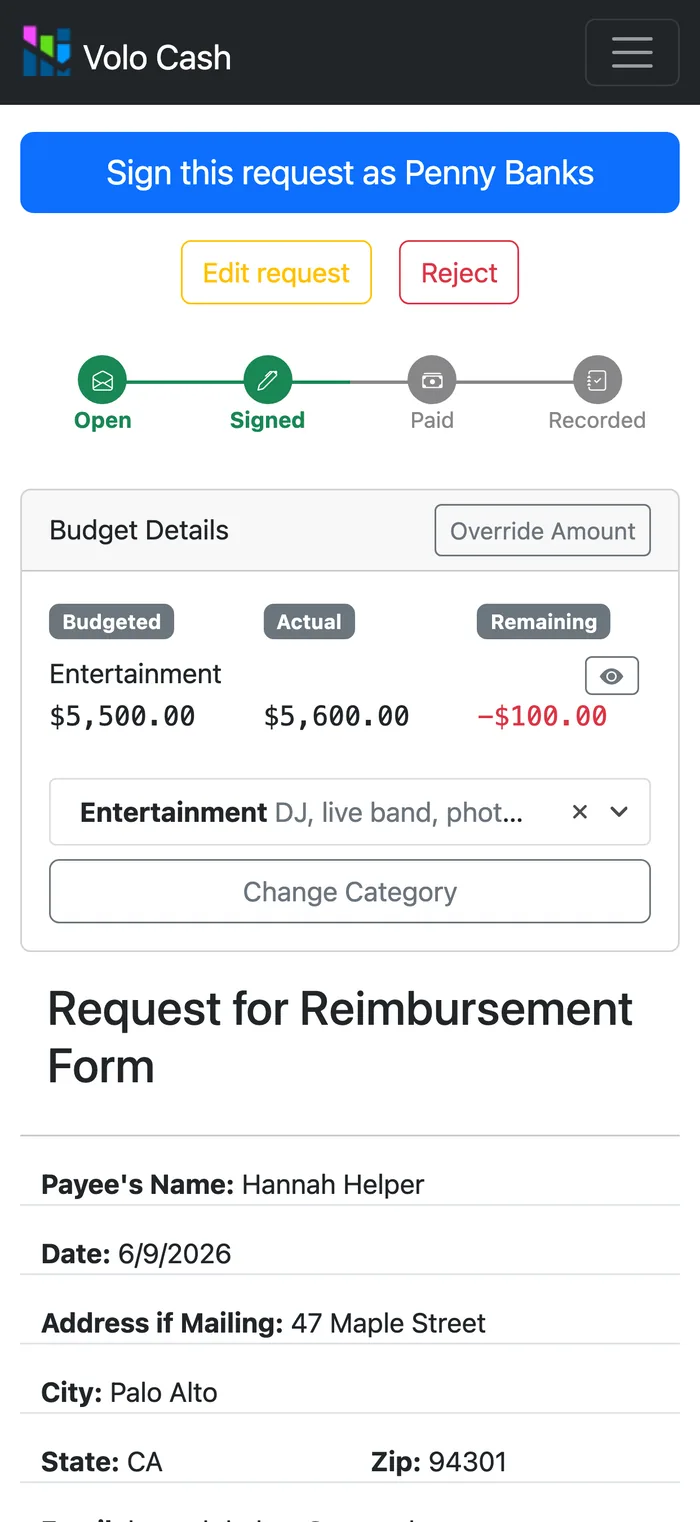
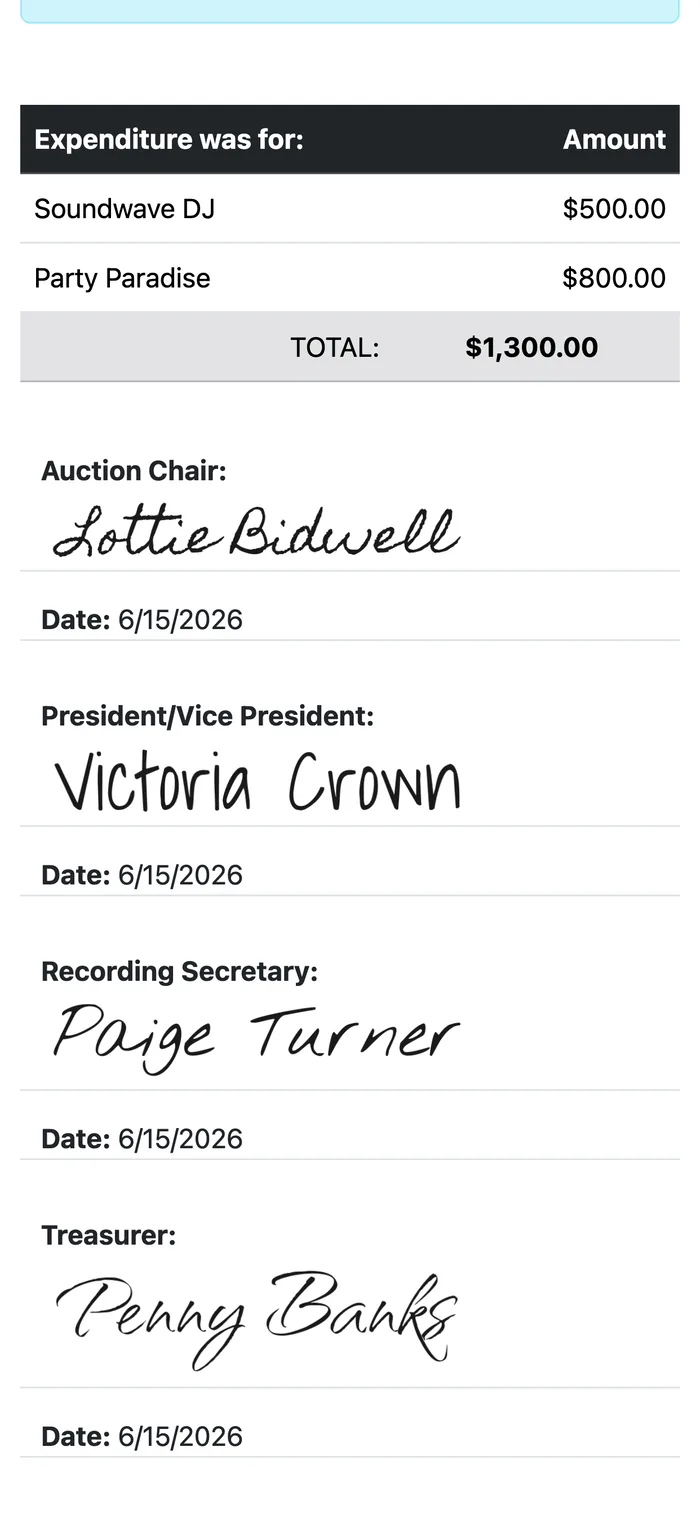
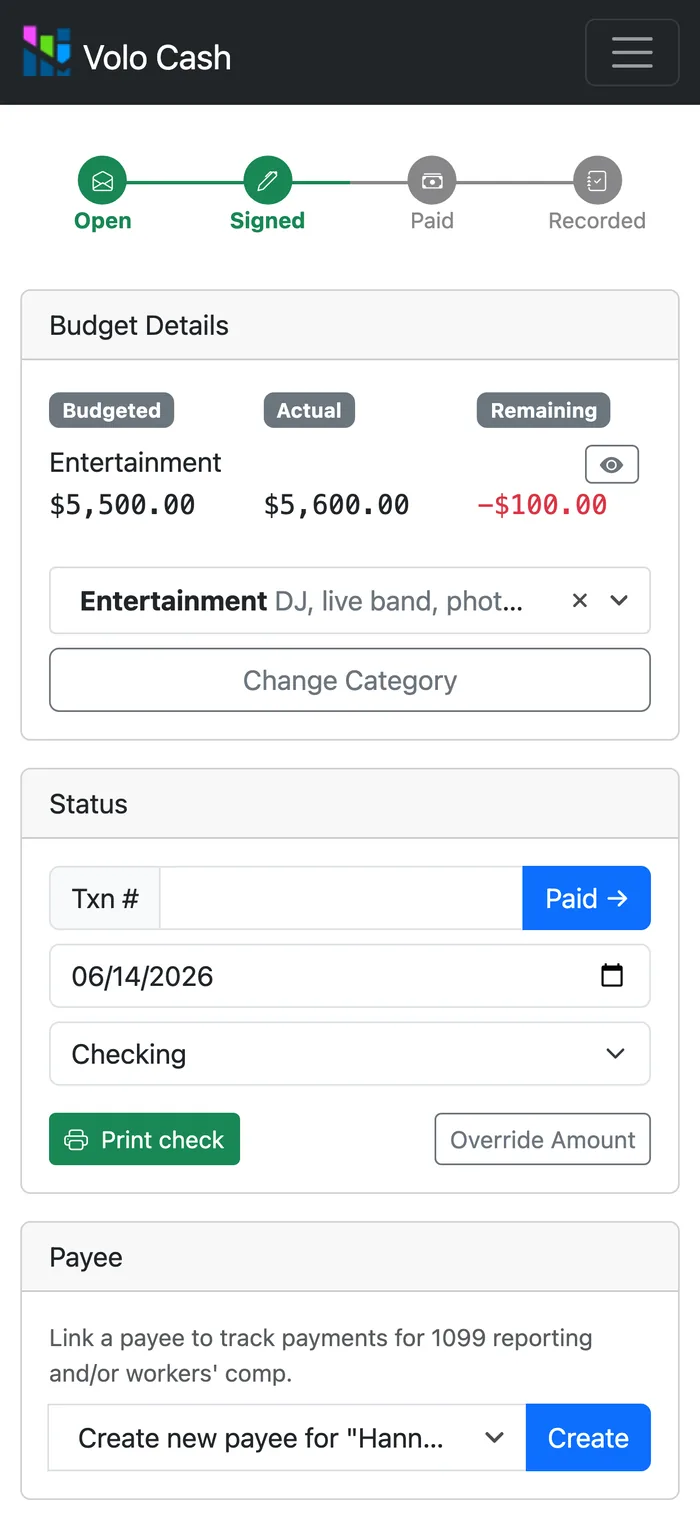
You can try it free for three months and set up your own organization’s sign-offs to see how they run.
For the full reimbursement journey these approvals sit inside, see the PTA reimbursement process, step by step. For a wider look at the tools in this space, see our honest roundup of the best PTA treasurer software.