
Handing off the PTA treasurer role means transferring three things: the records, the accounts, and the knowledge that lives in your head. A clean transition is closing out your year and getting the books reviewed, assembling a complete handoff packet, moving the bank signers and logins to the incoming officers, and passing on the operational details (vendors, passwords, recurring tasks, how payments actually get made) that no document captures on its own. Done well, it takes the new treasurer’s first month from daunting to routine.
I served as a PTA treasurer for three years across two school districts and trained the treasurers who came after me. The best handoffs took place over the course of a year with the outgoing treasurer remaining on the board in a different position. In those situations, my predecessor was aware of the challenges as they arose and had the right context when I had a question. And I got to pay that forward as I finished as treasurer, making sure to help out my successor in any way I could.
A quick note: the exact procedures, form names, and review requirements below vary by organization. Always check your own bylaws and your state PTA’s financial procedures. What follows is the shape most PTAs, PTOs, and booster clubs share.
Step 1: Close out the year and get the books reviewed
Finish your year before you hand it off. Reconcile the final bank statement, record any outstanding transactions, and make sure the ledger matches the bank. It can be a great training opportunity to do the last and/or first fiscal month with the incoming treasurer. Remember that people learn better by doing, so have your incoming treasurer do the work while you give light instructions.
Then get the year-end financial review or audit done. Most PTA bylaws require one before the new treasurer takes over, and it helps everyone involved. It gives the incoming treasurer a verified starting balance to build their year on, and it gives you a clear, board-acknowledged close to yours. Schedule it as part of the transition rather than leaving it for the fall, when a new treasurer is busy enough already.
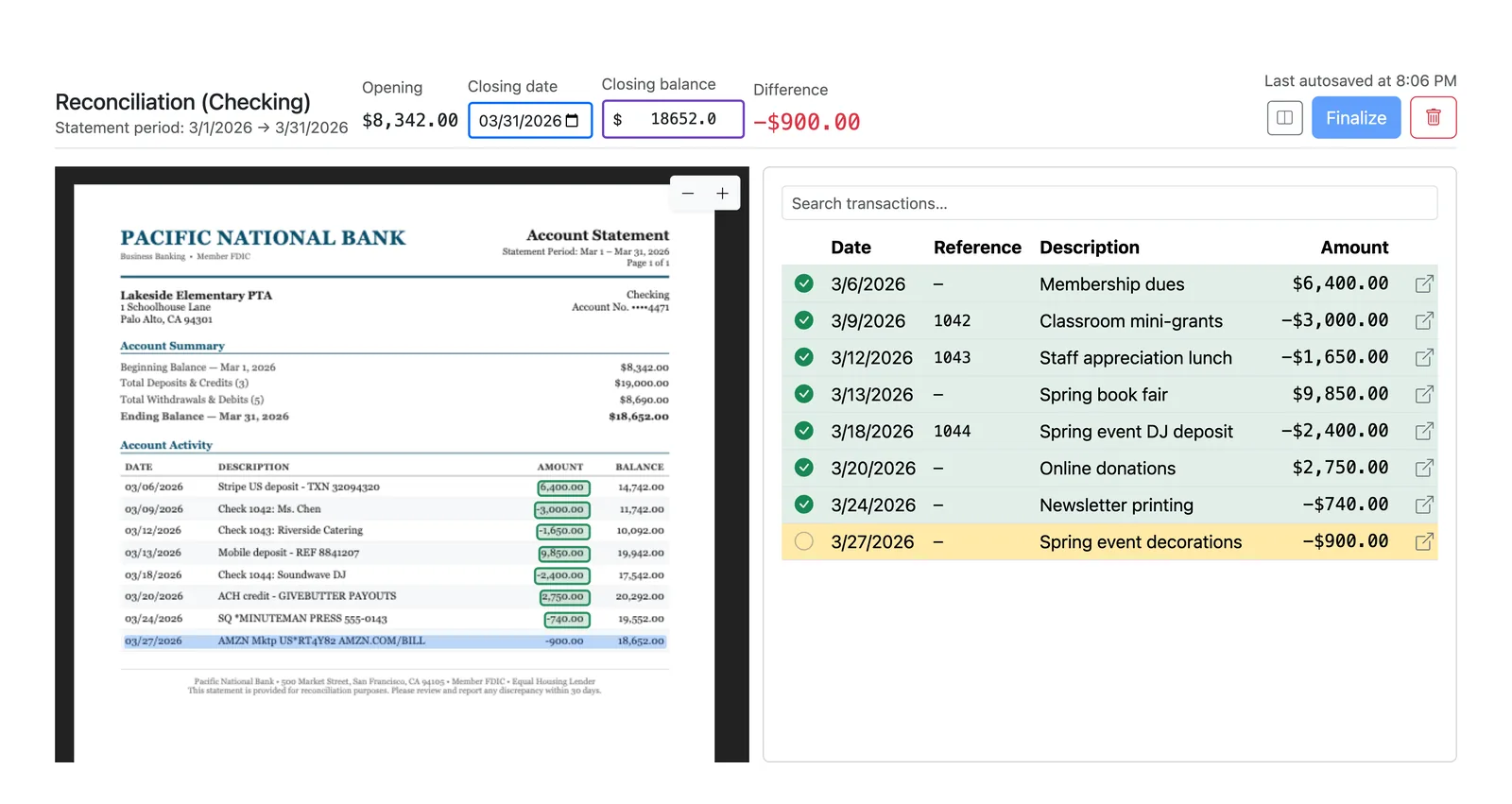
Click to match reconciliation in Volo Cash.
Step 2: Build the handoff packet
 The next treasurer should be able to understand the full financial picture from what you hand over. Assemble:
- The approved budget for the year
- The complete ledger or check register
- Every bank statement and monthly reconciliation
- The most recent year-end financial review or audit report, so the incoming treasurer has a verified starting line and knows the books were confirmed correct as of a specific date
- The current list of authorized signers, so they know who can sign today and what needs to change at the bank
- Any outstanding bills, uncashed checks, open reimbursements, or pledges, so nothing in flight gets dropped during the changeover
- The IRS 990-N or 990-EZ filing confirmation for the year, so they can see the annual return was filed and the organization’s tax-exempt status is current (three consecutive missed filings means automatic revocation)
- The W-9s on file and current vendor and payee contacts
Step 3: Transfer the accounts and access
This is one of the most important steps, and missing it can leave the PTA unable to pay vendors, reimburse volunteers, or even deposit donations.
- Update your authorized signers. Each bank will have a different procedure that you must follow to change the people who can write checks or spend money on your organization’s behalf. Typically, you’ll provide some combination of meeting minutes, photo ID, and bylaws. Add the new signers before removing the outgoing ones so the account is never left without two authorized signers.
- Remove your own access once the new signers are on. You should not remain a signer or keep a login after your term ends, and neither should any other departing officer. Lingering access is a liability and a security incident waiting to happen.
- Transfer the logins properly. The incoming treasurer should set up their own credentials for online banking, bill pay, and any software, not inherit your personal username and password.
Handle this at one of your final board meetings of the fiscal year (after the new board has been elected) and record the change in the minutes. The bank may require formal authorization, so the wording matters.
Here is what that motion can look like in your minutes:
US Community Bank account
i. Penny Banks, current Acting Secretary, will remove the following individuals as Authorizing Representatives and Signers from the US Community Bank business accounts:
- Buck Sterling
- Mark Shilling
ii. Penny Banks will then update the Authorizing Representatives and Signers on the US Community Bank business accounts as follows:
- Victoria Crown, President / Secretary
- Avery Segundo, Executive Vice President / Secretary
- Penny Banks, Treasurer / Acting Secretary
Note: many banks list every authorized signer under the title “Secretary” on the signature card, no matter which office they hold in your organization.
Step 4: Transfer the knowledge in your head
 The records show what happened. They rarely show how. The most useful thing you can pass on is the operational knowledge that would otherwise leave with you: how payments actually get made, how to handle taxes, the recurring obligations and when they come due, and the rhythm of what the treasurer does in each month.
Some strategies work better than others. The most reliable approach is to document the role as you go when the information is fresh. We cover how to do that, and how to make the right reminder reach the next treasurer at the right moment, in how to document the PTA treasurer role.
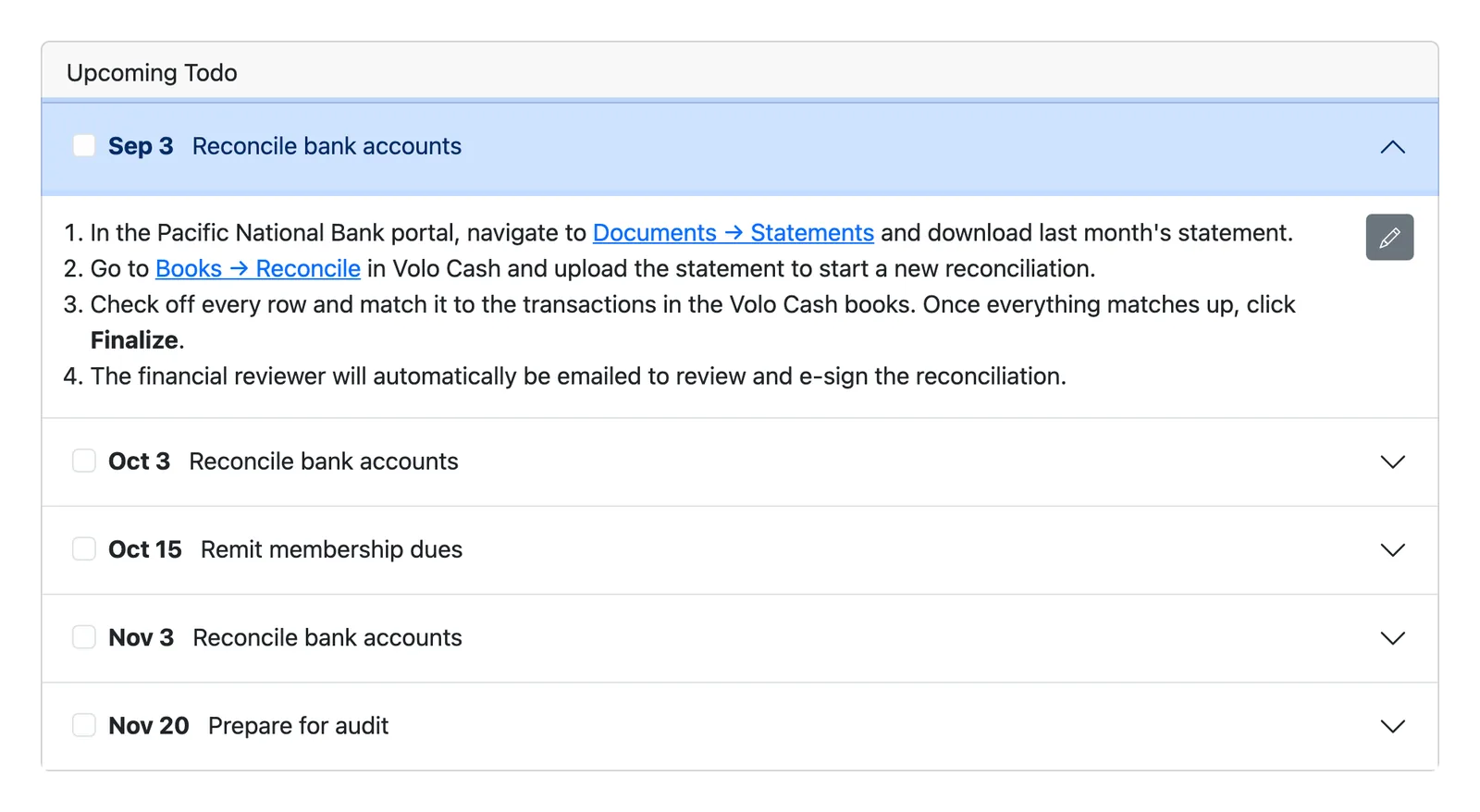
Fully documented recurring tasks in Volo Cash.
Step 5: You’re done!
That is the whole handoff. Here’s what the new treasurer ends up with:
- Final statement reconciled; ledger matches the bank
- Year-end financial review or audit done or scheduled
- Handoff packet assembled (budget, ledger, statements, reconciliations, review, signer list, open items, IRS confirmation, W-9s)
- Bank updated: new signers added, you and other departing officers removed
- Incoming treasurer set up with their own logins
- Operational knowledge written down (how payments are made, recurring obligations, vendors, the annual calendar)
Last year’s records are next year’s playbook
The question a treasurer asks most often is some version of “how did we handle this last year?” A searchable record of past expenses and bank transactions answers it on its own, even when you are not available to help the new treasurer.
And they are rarely the obvious questions. They are the small, specific puzzles that eat an afternoon when you are starting from scratch:
- Decoding a cryptic bank line. A matched gift from an employer giving platform like Benevity can land on your statement as something you would never recognize, such as “America Online Giving.” Last year’s record tells you what it actually was.
- Coding a charge with no request behind it. Software license fees that auto-renew get charged straight to the account without ever coming through an expense request. Seeing how the prior treasurer categorized them keeps your books consistent year to year.
- Chasing a loose end. A check that was written but never deposited, or a vendor whose mailing address you need, becomes a quick lookup instead of a round of emails.
- Picking the right budget category. When several adjacent programs could each claim an expense (is the Meet the Teacher breakfast back-to-school, staff appreciation, or hospitality?), how last year’s identical expense was coded settles it.
That is the difference between a year the next treasurer has to reconstruct and one they can simply look things up in, as long as your tools keep that history searchable.
Where Volo Cash fits
A challenging handoff is usually a symptom of a lack of time and the absence of tools that make it easy. Paper forms, a personal spreadsheet, and disorganized emails all add to the problem. Volo Cash was built so the transition is mostly automatic:
- The history stays fully searchable. Every approval and transaction is recorded, so the next treasurer inherits a complete audit trail. When they ask how something was handled last year, the answer is a search away rather than a text message to you.
- Documentation lives in the reminders. Build a richly documented calendar of the tasks a treasurer needs to do, from one-time items like preparing taxes and paying workers’ comp insurance premiums to the regular cadence of reconciliations and meeting prep, each with email reminders and detailed instructions on what to do and when. Think of it as your phone’s reminder system on steroids, automatically shared with every treasurer who comes after you.
- Role changes are handled natively. When a new officer takes over, Volo Cash retires the previous user and sets the new person up with their own identity, whether they log in with the role’s shared email (like treasurer@yourpta.org) or a brand-new one. The role and its history carry forward, and each person’s actions stay attributed to the person who actually took them.
- The books are already current. Because paid expenses post to the ledger as they happen, there is no backlog of bookkeeping for the next person to discover.
- 1099s and workers’ comp stay tracked all year. Volo Cash links each payment to a payee, flags which vendors still owe a W-9 or a workers’ comp certificate, and totals what each one was paid. When the January 1099 deadline or an insurance audit arrives, you run a report instead of reconstructing a year of checks, even for the payments made before you took over.
You can try it free for three months and set up a year that hands itself off cleanly.
And the other side of this handoff, for the person taking over from you, is here: taking over as PTA treasurer, your first 30 days.